Where to start…?

Our last blog post tackled the big question of why we are working on this mapping project. The next most common question is “where do you even start?” Getting started is actually very easy. Living in the county for 30 years has given me enough of a head start to know where to find the large cemeteries and the church yards. Once these larger properties are marked however, is when things get tricky. After that it’s all family plots, and these can be anything from dozens of graves to one single tombstone all by itself.

How do you know where to look for these you ask? Well I started with the locals. They are the experts on the area after all. The same families have been living and working here for hundreds of years. This is evident when you read the last names on the tombstones. You instantly recognize the surnames of friends, classmates, coworkers, etc.

So after asking around and talking to quite a few people I marked a paper map with all of the locations where people told me I could find graves.  This was especially helpful in the southern part of the county where practically everyone has a family plot either in their own yard, or knows of someone who has one near them. Also some of the larger burial grounds, church or public, were already marked on the paper map.

PaperMap

After local “questioning” my next step was interviewing some of the older folks in the community. A friend’s grandfather is very interested in genealogy and his family tree, so he invited me to come spend an afternoon with him and he showed me the locations on my map of even more grave sites, and directed me towards the owners or caretakers of the properties so I could gain access to those sites.

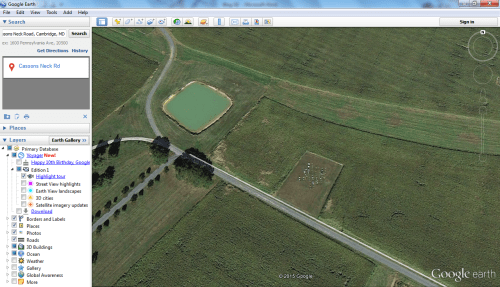
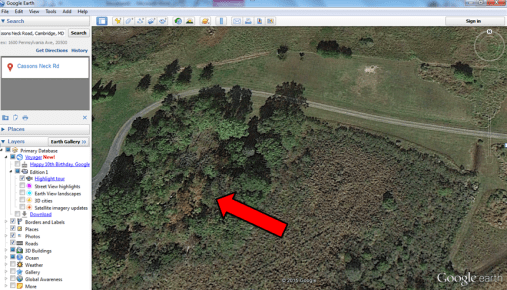
After people, one of the best resources I have for locating as many sites as possible is Google Earth. I use it to try and verify the tips received from people around the county. The biggest trouble I have run into is that some are so grown over you can’t really tell that they are even there without actually going to the site!
Arrow

There really are graves there! I promise!

Another method we’ve used is simply driving down the back country roads, places off the beaten track, and just looking around. Mostly it’s just enjoying the beautiful scenery, but sometimes we get lucky and find a great location. Additionally I would like to thank the Dorchester County Sheriff’s Office for keeping mental notes and telling me of the all the places they’ve spotted grave sites while out on their patrols.

Google Earth can also be used to try and find plots that no one has pointed out to us yet. This is the most time consuming part. Zooming in to a part of the county and then panning around, looking for something, anything that might mean grave sites.  Sometimes we are fortunate and can actually see the rows of stones on a property.

Railroad GE

  Spedden GE

Sometimes however we are simply panning around, looking for changes in agricultural patterns and then questioning the farmers on whether this is just an irrigation stop or perhaps something that warrants more investigation.

Stagecoach GE

As it happens, there actually were graves in the field shown above. That small circle in the middle of a soy bean field is someone’s final resting place.

As always, check back for more updates, but for now I’ll leave you with an interesting fact:

We have located 90 burial sites already, and haven’t even been south of
Church Creek yet!

Why are we here…?

The question I get from people most often when talking about this project is “Why?”. Apparently graveyards are not something people think about often. We go to a funeral, bury a loved one, and then move on with our lives, rarely thinking about that small stone in the ground. If you are lucky this cycle doesn’t happen often, If you are like me, it happens far more frequently than you would wish.

The answer is simple. Because. Because we are losing these sites to time and tide. Because some have no one to take care of them, because some are already past all hope of help. Because this is our heritage, our history.  Because there are so many stories out there to be told. Because these sites, no matter how small, or how old deserve the same respect and dignity of any of the large, for profit, cemeteries. Because I don’t believe anyone even knows where they are all anymore. And finally, Because if we don’t do it, who will?

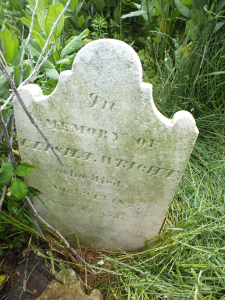
Some are easy to find. They can be right in someones front yard.

DSCF3141

Some take more time and effort to find and then get to…

DSCF1745      DSCF1743

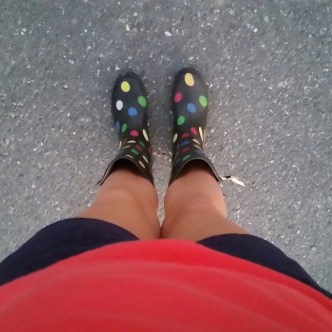
When strangers happen upon us at a burial site we get some of the strangest looks; surprise, disgust, suspicion… Cars slow down and creep by, I guess wondering why there are a handful of people in the cemetery taking pictures and holding strange electronics. After all nothing says mischief like a pair of rainbow polka dot rain boots…

boots

However we have been fortunate in our travels that there are many more people fascinated by what we are doing than repulsed by it. I was able to speak with a man who was volunteering his time to help rebuild one of the more historic churches in the county down on Taylor’s Island. In addition to a quick history of that church, he was also able to guide me to another grave site nearby and gave me a brief history of that one as well.

Sometimes curious neighbors come out and speak to me absolutely thrilled that their site will be featured in the project. I had a lovely conversation with a church elder who gave me a brief history of the church, some great facts about the neighboring historical buildings, and discussed with me the sad situation that since the church has recently been renamed, the church elders feel they have lost some of their identity. I wish I had the capability to record some of these conversations, or at least had an anthropologist on my team to know what to do with such cultural knowledge.

Always looking for volunteers.   Email us at dorchestergraves@gmail.com

Heroes and History

I wanted to dedicate an entire blog post to the Members of the Armed Forces. We have come across many, many military graves located around the county. For such a small area we have certainly produced a proud number of Soldiers, Sailors, Airmen, and Marines.

In addition to the hundreds of World War I and II service members laid to rest in Dorchester County, there are a notable number of military gravestones from Vietnam, and Korea, as well as campaigns as far back as the Spanish American War, the Civil War, the War of 1812, and even the American Revolution. The Revolution graves are usually marked with a medallion so as to be properly identified.

DSCF1999

Christ Church in Cambridge has a row of such graves. The medallion reads SAR 1775. Sons of the American Revolution.

              DSCF2220               DSCF2252

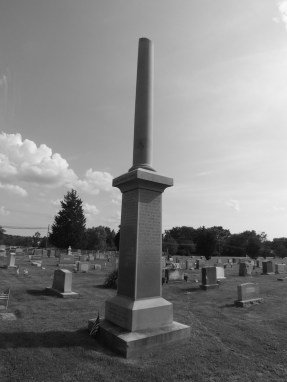
The monument on the left is for a French born sailor who served in the Spanish American War and the monument on the right is for the first man from Dorchester County to die in World War I. His ship was torpedoed off the coast of Scotland and he died on a life raft a few hours after the explosion from his injuries and exposure. He volunteered for service.

DSCF2105

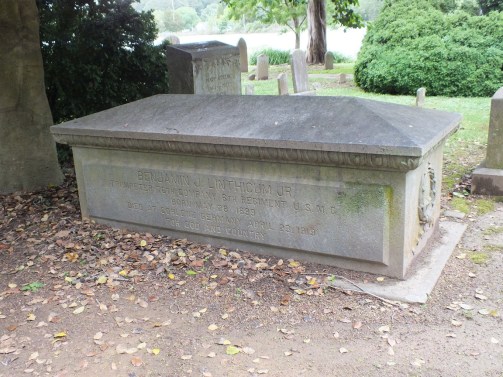
This crypt is for a young man who died in Coblenz, Germany during the United States Marine Corps campaigns during World War I. A fact of note is that this is the only above ground crypt in the entire graveyard.

DSCF2179

This graveyard is the final resting place for what appears to be three brothers who all served in the War of 1812. The 1812 Service Members are also identified with a marker. Sadly no further information is available for this family. I will have to do some more research and hopefully bring more of their narrative to light.

      DSCF2482         DSCF2481

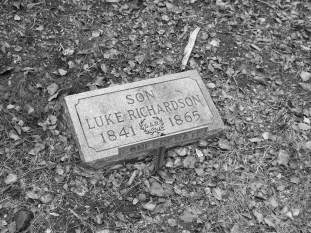
Everyone has heard the phrase “Brother against Brother” when speaking about the Civil War; Dorchester County had Father against Son.

DSCF3211

 This humble stone is the marker for Lieut. Colonel Thomas Woolford, leader of the 4th Maryland Regiment during the American Revolution. Wounded and taken prisoner in the Battle of Camden, SC, he was also part of the campaign to free Charleston from the British.

All of these stories are either amazing, heroic, tragic, or moving. They all deserve to be told. And yet, this is just a handful of the monuments around the county. This project has only covered about half of the area of the county, so there are still a great many more resting places as yet unmapped.

All of the information for these brave soldiers was gleaned from the monuments themselves or from 5 minutes on Google. If this much information was uncovered in such a short amount of time I would love to see what could be accomplished by a dedicated researcher.